
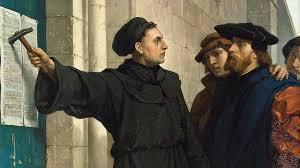
Luther’s marriage came during a period of deep religious change. In medieval Western Christianity, priests in the Latin Church were expected to remain unmarried, and nuns lived in religious communities under vows. The Reformation questioned many long-standing practices, and Luther argued that marriage was honorable for clergy as well as for ordinary believers. Katharina von Bora, who had left convent life amid the upheaval of the period, became not only Luther’s wife but also an important partner in managing their household, finances, and social life. Their marriage became a model for the Protestant pastor’s family, showing how theological change could alter daily life as well as public institutions.
More than two centuries later, June 13, 1774 brought another event with long-range consequences: Rhode Island became the first of Britain’s North American colonies to ban the importation of enslaved people. The measure did not end slavery itself, and enslaved labor continued elsewhere in the colonies and later the United States. Even so, the law marked an early formal move against the Atlantic slave trade in British North America. It reflected growing criticism of the trade on moral, religious, and economic grounds and formed part of a longer, uneven process that eventually led to broader abolition movements around the Atlantic world.
During the age of exploration and empire, this date also saw an important scientific and geographic milestone. In 1789, Captain William Bligh and part of the crew cast adrift after the mutiny on HMS Bounty reached Timor after an extraordinary open-boat journey across the Pacific. Their survival demonstrated remarkable navigational skill and endurance. The mutiny itself became famous in literature and film, but the voyage to safety also deserves attention for what it showed about seafaring, discipline, and the risks of long-distance ocean travel in the eighteenth century.
The nineteenth century added a major technological turning point. On June 13, 1886, King Ludwig II of Bavaria died under mysterious circumstances shortly after being declared unfit to rule. His death drew immediate attention because Ludwig was both a political figure and an influential patron of architecture and the arts. He is especially remembered for commissioning elaborate castles, including Neuschwanstein, which later became one of Europe’s most recognized landmarks. His life and death shaped the public image of monarchy in late nineteenth-century Europe and left a cultural legacy that continues through tourism, design, and popular imagination.
Science and innovation played a major role on this date in the twentieth century. In 1920, the U.S. Post Office ruled that children could no longer be sent by parcel post. A few families had used the relatively new postal service in this way when travel was difficult and postage was cheaper than train fare. The rule may sound unusual today, but it illustrates how rapidly modern systems were changing daily life and how governments often had to set boundaries as new technologies and services spread.
Only a few years later, in 1927, aviator Charles Lindbergh received a ticker-tape parade in New York City after completing the first solo nonstop flight across the Atlantic Ocean. His flight from New York to Paris captured worldwide attention because it showed the growing power of aircraft to connect distant places. Although long-distance flying was still dangerous and limited, Lindbergh’s achievement helped convince the public that aviation had a major future in transportation, communication, and international exchange.
June 13 also marks one of the defining moments in modern legal history. In 1966, the U.S. Supreme Court issued its decision in Miranda v. Arizona. The ruling held that suspects in police custody must be informed of certain rights, including the right to remain silent and the right to an attorney before questioning. The decision became widely known through the “Miranda warning.” Its importance extended beyond one case because it shaped police procedure, legal education, and public understanding of due process. It also influenced broader discussions in other countries about the balance between law enforcement and individual rights.
In the world of media and culture, this date carries significance for popular entertainment as well. On June 13, 1983, the Pioneer 10 spacecraft became the first human-made object to pass beyond the orbit of Neptune, according to the planetary positions at the time. Launched in 1972, Pioneer 10 had already transformed space science by sending back valuable data about Jupiter and the outer solar system. Its continuing journey symbolized a broader human drive to explore beyond immediate horizons, linking scientific research with public imagination about space.
A more recent event from June 13 came in 2000, when inter-Korean leaders Kim Dae-jung and Kim Jong-il met in Pyongyang for the first summit between the heads of North and South Korea since the peninsula was divided after World War II and the Korean War. The meeting did not resolve the conflict between the two states, but it marked a rare period of direct engagement. Families separated by war were able to reconnect, and the summit showed that even long-frozen political divisions can enter periods of dialogue, however limited or temporary.
This date is also notable for several influential births. On June 13, 1831, James Clerk Maxwell was born in Scotland. He became one of the great physicists of the nineteenth century by developing the equations that unified electricity, magnetism, and light. His work laid foundations for modern physics and for technologies ranging from radio to electronics.
In 1865, the Irish poet and writer W. B. Yeats was born. Yeats played a major role in modern literature and in the Irish literary revival. His poetry combined personal reflection, political change, folklore, and symbolism, and he remains one of the most widely studied writers in the English language.
The actor Basil Rathbone, born in 1892 in South Africa to British parents, became famous for his stage and screen performances, especially his portrayal of Sherlock Holmes. His interpretation helped define the character for generations of audiences and shaped detective storytelling in film and radio.
A very different public figure arrived on this date in 1928: John Forbes Nash Jr. The American mathematician made major contributions to game theory, a field that studies strategic decision-making. His ideas influenced economics, mathematics, political science, and later work in computer science. His life also brought public attention to the realities of mental illness and scientific achievement.
Looking across June 13, a pattern emerges. The day links religious change, scientific progress, political reform, exploration, cultural influence, and personal legacy.