
 This Day in History: October 19, 2026
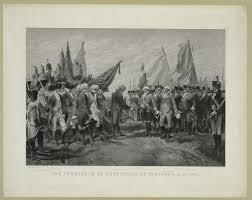
On October 19, 1781, British forces surrendered at Yorktown, Virginia, effectively ending the major fighting in the American Revolutionary War. American troops led by George Washington and French forces under the Comte de Rochambeau had surrounded the British army, while a French fleet blocked escape by sea. The defeat weakened British support for continuing the war and helped open the way to recognition of American independence in 1783. Yorktown remains important not only to United States history, but also as an example of how international alliances can determine the outcome of a struggle for independence.
Major Historical Events
1453: Bordeaux returns to French control
The surrender of English-held Bordeaux to French forces on October 19 marked the conventional end of the Hundred Years’ War. France’s victory at Castillon that July had already broken English military power in southwestern France. Bordeaux’s fall completed the recovery of the region.
The conflict, fought intermittently since 1337, had begun over competing claims to the French crown and control of territory. England retained Calais, but lost its other remaining mainland possessions in France. The outcome strengthened the French monarchy and ended England’s long effort to rule large parts of France.
1469: Isabella and Ferdinand marry
In Valladolid, Isabella of Castile married Ferdinand of Aragon, bringing together two members of the Iberian Peninsula’s leading royal houses. Their marriage laid the groundwork for a dynastic union after they inherited their respective crowns.
Castile and Aragon initially retained separate laws and institutions. Nevertheless, their rulers’ cooperation helped shape the emerging Spanish monarchy. Their reign later included the conquest of Granada, support for Christopher Columbus’s Atlantic voyage, and policies of religious uniformity that brought persecution and expulsion to Jewish and Muslim communities.
1781: The surrender at Yorktown
At Yorktown, more than 7,000 British and allied troops under Lord Cornwallis surrendered after a siege lasting about three weeks. Cornwallis did not attend the ceremony; Brigadier General Charles O’Hara represented him.
French naval control proved decisive. Without it, British ships might have reinforced or evacuated the trapped army. Although fighting continued elsewhere, the defeat changed political calculations in London. The 1783 Treaty of Paris formally recognized the independence of the United States.
1812: Napoleon leaves Moscow
Napoleon’s main army began withdrawing from Moscow on October 19 after waiting unsuccessfully for Russia to negotiate peace. Much of the city had burned following the French occupation, and the army faced worsening shortages.
Russian resistance, disease, hunger, and eventually severe cold devastated the retreating forces. The failed invasion weakened Napoleon’s military position and encouraged his opponents to renew their campaigns against him. It became a turning point in the wars that had reshaped Europe.
1900: Planck presents a new radiation formula
German physicist Max Planck presented a formula describing the radiation emitted by an idealized “black body,” an object that absorbs all incoming radiation. His formula matched experimental results more successfully than earlier explanations.
This October presentation was not yet his full quantum proposal. That followed in December, when Planck introduced the idea that energy was exchanged in discrete amounts. Together, these developments helped establish quantum theory, which later transformed the understanding of atoms, light, and matter.
1954: Climbers reach the summit of Cho Oyu
An Austrian expedition achieved the first confirmed ascent of Cho Oyu, the world’s sixth-highest mountain. Herbert Tichy, Joseph Jöchler, and Pasang Dawa Lama reached its summit without supplemental oxygen.
Their success formed part of a period of rapid Himalayan exploration during the 1950s. It also demonstrated the importance of relatively small expeditions and the skill of Himalayan climbers whose contributions were essential to these achievements.
1956: Japan and the Soviet Union restore relations
Japan and the Soviet Union signed a joint declaration ending the state of war between them and restoring diplomatic relations. Although World War II had ended in 1945, unresolved disputes had prevented a normal relationship.
The declaration supported Japan’s admission to the United Nations later that year. It did not settle the territorial disagreement over islands northeast of Hokkaido, however, leaving a major obstacle to a formal peace treaty.
1974: Niue becomes self-governing
The Pacific island of Niue became self-governing in free association with New Zealand. The arrangement followed a United Nations-observed referendum and gave Niue responsibility for its internal affairs.
Niueans retained New Zealand citizenship, while the relationship preserved arrangements for assistance and cooperation. This represented one of several paths Pacific territories took during decolonization, rather than following a single model of independence.
1987: Markets fall on Black Monday
Stock markets plunged around the world in a crash remembered as Black Monday. In the United States, the Dow Jones Industrial Average fell 22.6 percent, its largest one-day percentage decline.
No single cause explains the collapse. Concerns about economic conditions, trading practices, and market structure all contributed. Automated selling strategies intensified the pressure in some markets. The crash prompted reviews of financial safeguards and helped lead to trading pauses known as circuit breakers.
Notable Births
Auguste Lumière, born in 1862
French inventor Auguste Lumière, working with his brother Louis, helped develop the Cinématographe, which could record and project moving pictures. Their public screenings in 1895 became landmarks in cinema’s early development. Filmmaking emerged through many inventors’ efforts, but the Lumières helped turn it into a shared public experience.
Subrahmanyan Chandrasekhar, born in 1910
Born in Lahore, then part of British India, Chandrasekhar became a leading astrophysicist. His work established the mass limit above which a white dwarf star cannot remain stable. This helped explain how stars evolve and collapse. He shared the 1983 Nobel Prize in Physics.
John le Carré, born in 1931
British novelist David Cornwell, known by his pen name John le Carré, drew on his intelligence-service experience to write about espionage. Books such as The Spy Who Came in from the Cold explored divided loyalties and the personal costs of secret work, influencing modern spy fiction.
Evander Holyfield, born in 1962
American boxer Evander Holyfield won world titles at cruiserweight and heavyweight. Remembered for his endurance and major championship contests, he became one of the most prominent fighters of his generation.
Notable Deaths
Jonathan Swift, died in 1745
Anglo-Irish writer Jonathan Swift used satire to examine politics, social inequality, and human behavior. Gulliver’s Travels and “A Modest Proposal” remain widely read examples of how imaginative writing can challenge accepted ideas.
Ernest Rutherford, died in 1937
New Zealand-born physicist Ernest Rutherford helped establish the nuclear model of the atom. His research on radioactivity and atomic structure changed physics and laid foundations for nuclear science. He received the 1908 Nobel Prize in Chemistry.
Camille Claudel, died in 1943
French sculptor Camille Claudel created expressive works exploring movement and human relationships. Her career was constrained by financial hardship and institutionalization. Later exhibitions restored attention to her achievements as an artist in her own right.
Jacqueline du Pré, died in 1987
British cellist Jacqueline du Pré gained international recognition for performances of exceptional warmth and intensity, especially her interpretation of Elgar’s Cello Concerto. Multiple sclerosis ended her performing career early, but her recordings continued to influence musicians and listeners.
October 19 brings together changes in borders, scientific understanding, political relationships, and artistic expression.